Saturday, March 10, 2012

The moral right to kill those who don't meet your standard

Just recently the Sydney Morning Herald, Friday Mar 2, 2012 and then Andrew Bolt in the Telegraph  pointed out how Philosophers have argued that "since" a foetus and a newborn are equivalent in that they lack a sense of their own life and aspiration then killing them, even if they are healthy can be justified on grounds like the mother is unwilling to care for it.
Now we have in such arguments long been told that the "slippery slope" objection doesn't carry any weight, however here we have clear evidence of just this when one has moved from arguing for abortion of a foetus to arguing on the same grounds for the killing of a newborn.
Some might object that we don't want to give an emotive response to these sorts of objections but as being more than a rational being, namely, emotionally geared as well, we do not fear responding in part this way.

However, two things follow from what these "philosophers", Alberto Giubilini and Francesca Minerva are arguing. And that is that on grounds such as "lacking a sense of their own life and aspiration" then you can readily apply this to people with disabilities and things like alzheimers and the like and then decide to do away with them as well, something historically already we have seen in the days of Hitler's regime. It is not good enough to say neurologists and psychologists can determine self-awareness, for in a foetus case, this is built upon a grab bag of presuppositions and one's worldview. After all, the problem of defining  person is evidence of the clash of different worldviews already such as the Christian / Biblical Worldview and that of secular humanism.

If some find this a "well reasoned argument", then we need to point out that some things in life are morally repugnant, and even most who hold a worldview that cannot account for such repugnancy admit that. So people readily admit that torture of children and adults is morally repugnant, that a person such as a mass murderer are "evil", Pol Pot comes to mind, as does Idi Amin of Uganda, or more recently as evidenced by the viral video about kony. What I am suggesting is that ideas are not argued in a vacuum as though they have no impact on ones life. I would argue that what one does in private arising as it does out of their worldview, their ideas and things they value work out in everyday life. It effects how a person relates publicly to others. As someone once put it - ideas have legs!

What Christians must keep on saying is that a person is valuable because they are made in God's image. And that image is stamped at conception. Infanticide has been with us a long time, the Romans practised it, but that doesn't mean we have to. Euthanasia is not a valid option either.
And when you add to the mix that all people are sinners, that is, they are guided by the promotion of self to the detriment of others, this is not the kind of thing you want mankind determining. After all our politicians regularly stuff up things they are meant to oversea and bureaucrats likewise do not leave you with much confidence.

The words of Alberto and Francesca are chilling when they argue
if economical, social or psychological circumstances change such that taking care of the offspring becomes an unbearable burden on someone then people should be given the chance of not being forced to do something they cannot afford.
So economics and 'being put out' becomes reasons for killing someone they that seems to justify any murder. How would the legal system then prosecute murders? Would it be on the basis of 51% don't like such and such? or other people have been upset by seeing or being effected by the murder of a loved one or someone they know? The ramifications for the order and rule of society would be horrendous.

However, in the end I suggest that people who put forward such ideas live in a world where they don't have a basis for or being able to account for morality in which case they really ought to deal with the ramification of their godless ethics where might and majority rules, regardless of right and justice.

Somethings to ponder eh?

regards
Gary

Monday, February 13, 2012

The Emperor has no clothes - economic and cultural crash

When I was a boy I remember being told the story about the emperor with no clothes and how he foolishly took the word of his advisers, but then one small boy saw the truth and spoke up. Sadly today we can report what is obvious to some, which is that there is coming a great financial crash to rival any in the past. And still we have those who man the ship and are the economic mouthpieces of our media elite, ridicule such observations. Perhaps it is that they fear speaking up on such issues believing that in so doing it will become a self-fulfilling prophecy. But the fact and the reality are out there for those who will take a moment and investigate.

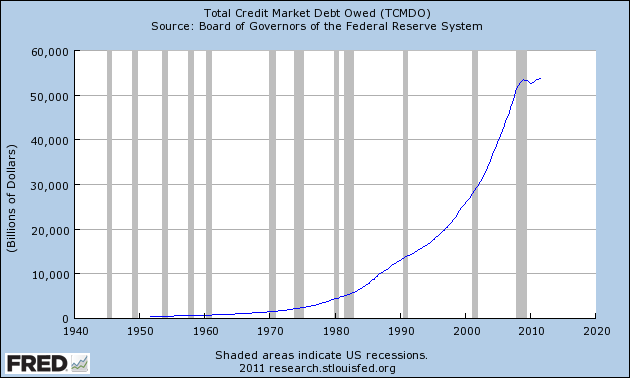
America's debt is beyond recovery. Apart from the current National debt in America passing the 15 Trillion mark, having gone up from 10 trillion dollar mark in 2008, there's the added unfunded liabilities such as Social Security and Medicaid which in effect take their national debt to around 100 Trillion dollars. That is almost unfathomable and yet it is politics as usual in The House and Senate and the White House in America. No one is willing to make the hard decisions. They all want to feather their own nests.
Consider the chart below as provided by the Federal Reserve Board.

Total Credit Market Debt Owed
and then read Michael Synders blog at theeconomiccollapseblog.com

Something to mull over isn't it? Here in Australia we have the same attitude - stick your head in the ground and hope it will all go away.
Yet it isn't just an economic crash we are speaking of is it? How will people respond in the midst of being left destitute and perhaps so destitute they wonder how they will feed themselves and their family? Will they be like the children in Lord of the flies? The Bible warns us many will be lovers of themselves, void of any love for parents or others. That is what we are already seeing happen around us today in our culture.

In the midst of all this, truly only God's peace will suffice.

Gary

Friday, January 6, 2012

Hospitality and Jesus

What would you give or do to have a meal with Jesus?
What about with one of his trusted inner circle of disciples? His special chosen ones?
What about with one of his other disciples or Paul? His special chosen ones?

What would you give? Give up? or do for that?

Then Why do we find it so hard to practice hospitality to one of His Chosen in the church?
His special Chosen ones!

Tuesday, December 20, 2011

Culture and Christianity the debate continues

Just yesterday Tim Keller wrote that the "Cultural Transformationists" and the "Two Kingdoms" adherent were getting closer in fairly representing and debating the issues than ever before, a good thing for Reformed Evangelicals. He clarifies the issues and it can be read here. As Keller describes it, Transformationists "Though different in significant ways, they all believe Christians should be about redeeming and changing the culture along Christian lines." Two Kingdom adherents "the opposite---that neither the church nor individual Christians should be in the business of changing the world or society"

Michael Horton doesn't agree totally with Keller's description of the "Two Kingdom's" view so that also needs careful persual read it here.

A must read is the article in Themelios by Dan Strange which is very thought provoking about these issues. However it is a footnote in this article by Strange that I want reflect upon in terms of considering a person's assumptions in the arguments the Culture itself presents as cogent, reasonable and "convincing".
Consider Stranges footnote #72

As Julian Rivers pointed out in 2004, ‘It may be that a culture deviates in some respect from the law of God to such an extent that some moral positions seem defensible to Scripture alone. We may rapidly be reaching that point in the Western world as regards sexual ethics’ (‘Public Reason’, Whitefield Briefing 9:1 [May 2004]: 4). One thinks here of a country like Switzerland currently discussing the decriminalization of consensual incest and the U.S. case of David Epstein, charged with having a three-year affair with his adult daughter. Epstein’s lawyer said to ABCNews, ‘Academically, we are obviously all morally opposed to incest and rightfully so. At the same time, there is an argument to be made in the Swiss case to let go what goes on privately in bedrooms. It’s OK for homosexuals to do whatever they want in their own home. . . . How is this so different? We have to figure out why some behavior is tolerated and some is not’
(
http://www.huffingtonpost.com/2010/12/15/david-epsteins-lawyer-we-_n_797138.html).
To which I hope that we’d point out the assumption behind the thinking that ‘what is carried out in private is of no concern to anybody else’ is “that what I do in private doesn’t affect anybody else”. But this ignores how such activities affect one’s character and relationships in the public sphere. One cannot divorce their worldview that allows and condones such behavior from how they relate the rest of the time in public.
Just something to ponder.
regards,
Gary

Tuesday, November 22, 2011

Why Twitter is an idol

Just recently I saw a great articles labeled iphone, ipad, idol -  apart from being witty it was pretty much right on.
It got me thinking when on the evening news there was a piece about twitter. If you reflect upon it, twitter is all about me. People tweet their latest irrelevancy, what I am eating, what I am doing this instant, where I am going, who I am meeting, my observation of some item of culture or news or fad or point of view in less than 140 characters.

In that sense alone it is an idol because that idol is ME.

Now perhaps people are looking for intimacy, for connection on a relational level. But twitter doesn't promote it because it is a one sided conversation - it is "one hand clapping" because it doesn't allow for interaction, it doesn't allow for another person to respond. At least in a blog people can comment and you can enter into a dialogue with them.

However, there's another reason that Twitter is an idol and that is very intimately tied to the medium. It is because Twitter, being limited to 140 characters, and being used by so many people to post unconnected irrelevancies that it provides no context in which to understand the person making them. You would need a person to post minute by minute their life and You, yes You would have to read them just to get a bit of the context of their life and experiences so that you would get some meaningful context for what is being said.
In the end, who is going to read such a one sided monologue with a twit on the other end :)

Now of course you could say that you already know the person however much of the tweets people love to receive are of people that they actually don't know all that well.

So let me encourage you, sit down have a coffee and talk together. Ask them something about them, instead of focusing on hearing your own voice. You will gain so much more from being other person centred.

In Christ,
Gary

Wednesday, November 16, 2011

How Mark Driscoll prepares his sermons is not something a pastor would want to emulate

Over at Sermon Central is the summary of Mark Drsicoll's facebook chat about Preaching and his Q & A. I hope pastors would be a little wary of trying to imitate Mark.
Mark Driscoll begins his discussion by admitting that his approach is both unorthodox and not something that others should copy. One asks then what is the benefit of talking then about his method? If it is merely to engage others and discuss helpful insights, OK, but he does spend a lot emphasizing speech and 10000 hours of preaching.

His first disclaimer is that the Bible speaks very little on preaching, however that is not helpful at all in that what it does tell us is very instructive for our preaching and is adequate to know what things are central in Preaching.

You can read volumes on Preaching and it’s basis in Scripture.

When someone says this we need to take a second look and see what Scripture says on this matter. It tells us from the OT for example that the Scribes read the Word and gave it’s sense to their hearers. Too little is said in this “discussion” regarding 1. That we are called to faithful teach the Scriptures and 2. Preachers model to the flock by their preaching how to interpret God’s Word and then apply it.

Mark talks about how his early preaching was terrible, but to say pragmatically that if you get to 10000 hours of preaching you will be quite better misses the point. It doesn’t necessarily mean you will be a better preacher, that is, one faithful to the Word, it just means you’ll be a better speaker, more comfortable with your “presentation.” But our calling is to faithfully and accurately divide the word and declare its sense so that people may apply it to their lives.

Mark has a degree in speech and there is no doubt he is a good speaker and captivating communicator but that does not mean he is necessarily a good exegete making clear the Scriptures and applying them to his hearers. I remember his sermon on worship from the book of Revelation chapter 5 where he is novel in his interpretation and not consistent with the text. Doesn’t he realize in his preaching he models for the flock his method of interpreting and applying the Scripture? This is a serious and lofty calling, to preach the Word of God.

Does that mean we always get it right? No, but because we are accountable to the Lord we deal carefully with the Word of God and secondly, being accountable to the flock including the elders we are able to be corrected and come back to the flock to say I was wrong at this point, or need clarification what I was trying to say.

And what does it say of your regard to the flock when we hear you say all my early sermons were terrible until I got my hours up? If you mean your delivery was painful, ok, but surely Mark you are not suggesting that your exposition of the text was wrong.

Be aware my friends of these things and don’t treat such comments lightly. You just cannot equate prep time with the amount of time you spend preaching it. No matter how many books you read or write. Now we may be too harsh at this point, after all he did say “for various projects ( perhaps we should understand here ‘sermon series’ ) I am reading and studying all the time” which implies sermon preparation is actually longer than the one hour or so he starts off mentioning. If this is so, then we need to understand, that this time of study is actually part of the prep time for a sermon.

I do hope at this point he also means he is considering the passage in context and doctrinally as well as considering the original languages and what they point out.

In this case preparation for most preachers just cannot be done by most people in about an hour no matter if they have a photographic memory or not.

Just a few thoughts to ponder

In Christ,

Gary

Friday, November 4, 2011

Shane Hipps don't think much about hell either

I am so glad Shane Hipps is not my teaching pastor!
He is Rob Bell's replacement at Mar's Hill but his understanding on Hell shows no Biblical understanding at all.

His "argument" is predicated on truth being what someone experiences. perhaps he is a poached egg but hasn't experienced it yet.

What these guys so blatently neglect is the Authority of God's Word the Bible. They want to pick and choose what suits their Reason, but they fail to see that it is only in the Scriptures that we are told to trust that Jesus' death on the cross makes you rught with God.

Gary