John Krakauer, author of Into the Wild has written a piece on the New Yorker in which he again investigates how Chris McCandless died.
It makes a case for ODAP poisoning leading to starvation. Yet what is required for the effectiveness of ODAP poisoning is that one be severely suffering from malnutrition, stress and acute hunger. In the end it makes for a tragic story of a self centred life.
Gary
Showing posts with label Worldviews. Show all posts
Showing posts with label Worldviews. Show all posts
Monday, October 6, 2014


Wednesday, September 3, 2014
Standing against the evil of ISIS
Trevin Wax over at the Gospel coalition write a succinct and thoughtful article about dealing with evil correctly. interacting with President Obama's address.
You can do well to read it and discuss it with your friends and neighbours.
Pray not just of the safety of Christians in Iraq but also for Muslims being murdered, and for young Muslims not to fall for this evil.
Gary
You can do well to read it and discuss it with your friends and neighbours.
Pray not just of the safety of Christians in Iraq but also for Muslims being murdered, and for young Muslims not to fall for this evil.
Gary
Wednesday, July 30, 2014
Authentic Christianity
An Authentic Christian is probably best summarized in the Beatitudes. What it means to be a Christian encompasses at least all of what Matt 5:1-14 speaks of.
My mate Rob drew attention to the following two points:
And ideally it is the God – Man Jesus who best exemplifies these attributes – he is the perfect Authentic Christian ( man ).
And when we say perfect we don’t mean holy as a moral attribute but wholly as set apart for a purpose and being that! That is, perfect means doing what it was created for!
Now part of that coming to grips with being a Christian is to take notice of the rebuke of God where that occurs, not shirking it off and quickly turning to the more sating passages of God loving us and dying for us and other favorite themes.
Some today think it is harsh when a preacher points out the ramifications of a passage that speaks rebuke.
It’s like some prefer to think “Well God is just all on about encouragement, there’s no place for pointing out in detail or applying it in particular way because that is rattles my comfortableness and complacency. “ We think to ourselves “ I quite like going to church once a week and worshipping there” – and here I am being very generous with myself about the once a week bit. Sadly it is so easy to make God up in my own imagination – a personal God who is comfortable and doesn’t expect too much of me.
Yet what am I to make of all those passages that begin in Genesis that point out that God is unhappy with our ( mankind’s] behavior and holds us to account – Israel’s history is full of the consequences of ignoring God. It brings about the judgment he has already warned about.
In Christ, again it is true that we are graciously saved, and that not by our own works, but we need to hear again that after salvation He calls us to obedience. Not that obedience saves us, but rather an obedience that pleases Him. He wants for us to be made in the likeness of Christ, the perfectly obedient man! The second Adam as Paul would say.
And this is also for our benefit. To be in God’s place is to be in the right and best place even if we don’t want to acknowledge that or it disheartens us that there is a continual struggle against the flesh the world and the devil.
It is so easy to gripe against a preacher who points out our failure to obey Hebrews 10:25 “let us not forsake the meeting together.. as some do.” You see the “let us” is not a suggestion, it’s a command. And it warns us that in actuality, some are in fact doing this, that is what the text, God’s Word, says!
But if we gripe about that what about when the preacher preaches on Revelation 2-3? Has the preacher just lightly skipped over what is said in the letters to the 7 churches and merely read out the verses? Or has he failed to clearly apply it or have we become so hardened that we gloss over what he has said and the Word of God itself says? What are we to make of the warning that we are neither hot nor cold and He will spew them out of his mouth? Is that just them or is it possible some of us are in the same boat? After all why is it there in Scripture, God’s letter to us, anyway? Is it just padding and something that is intended to tickle our ears and make us point the finger at others? God forbid.
The Great Commission doesn’t say go out and make converts - after all, that is what God does, rather it says make disciples and they are people who follow Christ and do as he says. After all the verse actually says “teaching them to obey everything I have commanded”.
O that I would be sanctified in Obedience to You O Lord.
Tuesday, June 3, 2014
Daniel 1 Living in a warped Culture
As I was talking with my younger daughter about the significance of Daniel 1 I was reminded of an experience I had when I was first off to University. I remember a concerned member of our congregation expressing alarm that I was studying philosophy at University. Her alarm was right to be voiced but her understanding of being helpful wasn't well thought out.
Today I have similar feelings about certain subjects being taught at University, some with their non-Christian worldview blatantly set forth in their teaching about the nature of mankind. Subjects such as Psychology, which set forth a view of man that is many times antithetical to the Christian understanding. Yet perhaps just as dangerous are those subjects that assume such views but are not forthcoming about those assumptions.
So what is one to do about this? Do we tell our young people that they just shouldn't do such subjects?
Here Daniel 1 gives us practical insight and guidance.
Daniel and his friend were taken off into exile to Babylon, a pagan and demonic culture. He was taken into the Kings palace to learn their language and customs and culture. Did he object? No. not even when they changed his name to represent that of one of the pagan gods of the Babylonians.
Only at one point did he object. At the point of food and wine from the kings table, because such was defiled.
But it wasn't objected to by Daniel because of his feelings. Not even because he didn't like that food. After all you would be hard pressed to make me eat eyeballs as some cultures do. But that wasn't Daniels reason for acting as he did.
Rather it was because of was forbidden by the word of God. As we find in Deut 32.
What this passage tells us that one can be godly in the midst of a pagan culture, even when learning their culture and language and customs. Still even when learning these things it doesn't mean one has to agree with them or have them assimilated it into their own lives.
So the helpful thing for our young people is to prepare them rightly for living in a pagan culture which is done by grounding them in the clear Word of God as evidently Daniel and his friends had been before the exile!
It means understanding God's Word and talking about such practical ramifications as Daniel met in the Culture he was dragged into and the Culture we are born into!
In Christ,
Gary.
Today I have similar feelings about certain subjects being taught at University, some with their non-Christian worldview blatantly set forth in their teaching about the nature of mankind. Subjects such as Psychology, which set forth a view of man that is many times antithetical to the Christian understanding. Yet perhaps just as dangerous are those subjects that assume such views but are not forthcoming about those assumptions.
So what is one to do about this? Do we tell our young people that they just shouldn't do such subjects?
Here Daniel 1 gives us practical insight and guidance.
Daniel and his friend were taken off into exile to Babylon, a pagan and demonic culture. He was taken into the Kings palace to learn their language and customs and culture. Did he object? No. not even when they changed his name to represent that of one of the pagan gods of the Babylonians.
Only at one point did he object. At the point of food and wine from the kings table, because such was defiled.
But it wasn't objected to by Daniel because of his feelings. Not even because he didn't like that food. After all you would be hard pressed to make me eat eyeballs as some cultures do. But that wasn't Daniels reason for acting as he did.
Rather it was because of was forbidden by the word of God. As we find in Deut 32.
What this passage tells us that one can be godly in the midst of a pagan culture, even when learning their culture and language and customs. Still even when learning these things it doesn't mean one has to agree with them or have them assimilated it into their own lives.
So the helpful thing for our young people is to prepare them rightly for living in a pagan culture which is done by grounding them in the clear Word of God as evidently Daniel and his friends had been before the exile!
It means understanding God's Word and talking about such practical ramifications as Daniel met in the Culture he was dragged into and the Culture we are born into!
In Christ,
Gary.
Saturday, September 14, 2013
Global Warming, the Climate and bad arguments
The Sydney Morning Herald on Friday Sept 12 included an article titled 'Climate sceptic puts hand up for science portfolio' in the new liberal Cabinet.
Western Australian MP Dr Dennis Jensen who has a Masters degree in Physics and a PhD in material Science questions the scientific consensus that humans are contributing to global warming.
Whether he is right or not, at least he points out that appeals to Authority or appeals to consus are not Scientific at all. They are flawed arguments. what needs to argued is the Scientific evidence.
Who said something is irrelevant, and how many claim something to be true is also. what matters is Scientific reality.
How refreshing
In Christ,
Gary
Western Australian MP Dr Dennis Jensen who has a Masters degree in Physics and a PhD in material Science questions the scientific consensus that humans are contributing to global warming.
Whether he is right or not, at least he points out that appeals to Authority or appeals to consus are not Scientific at all. They are flawed arguments. what needs to argued is the Scientific evidence.
Who said something is irrelevant, and how many claim something to be true is also. what matters is Scientific reality.
How refreshing
In Christ,
Gary
Wednesday, September 11, 2013
Tactics for Discussing your Christian convictions from Gregory Koukle
Found at Amazon Gregory Koukle's new book Tactics: a game plan for discussing your Christian Convictions.'

A snippet that helps us deal with a common objection by Koukle is as follows
“That’s the part that confuses me. Why is it when I think I’m right, I’m intolerant, but when you think you’re right, you’re just right? What am I missing?”
Of course, you are not missing anything; she is. Her move is simple name-calling.
Labeling you as intolerant is no different than calling you ugly. One is an attack on your looks. The other is an attack on your character. Neither is useful in helping you understand the merits of any idea you may be discussing.
A powerful encouragement
In Christ
Gary

A snippet that helps us deal with a common objection by Koukle is as follows
“That’s the part that confuses me. Why is it when I think I’m right, I’m intolerant, but when you think you’re right, you’re just right? What am I missing?”
Of course, you are not missing anything; she is. Her move is simple name-calling.
Labeling you as intolerant is no different than calling you ugly. One is an attack on your looks. The other is an attack on your character. Neither is useful in helping you understand the merits of any idea you may be discussing.
A powerful encouragement
In Christ
Gary
Sunday, August 25, 2013
Carson's 'The Gagging of God'
Great insights from Carson 'The Gagging of God.'
Some may have inferred from my previous post that not much is gained from Carson’s ‘The Gagging of God.’ That is just not true. Apart from the fantastic and novel title - the Gagging of God. Which pictures for some the handkerchief stuffed in the mouth of God to prevent him speaking to us – and well, it may just be that on a postmodernistic reading of the bible because the bible on their hermeneutic just ends up being what they want to hear. But really the gagging also picks up Revelation 3 where man’s behavior in the church at Laodicea elicits from God a gagging – and he spews them out of his mouth. But there are other gems in this great tome. On page 467-468 he talks about how a missionary told him of his release from his background of an abusive father which had left him with a distorted view of Father, and found it difficult to give and receive love, especially about feeling the love of Christ, a release which came about by a practice called “rebirthing”. How pastorally sensitive is Carson by affirming he is glad his life is more integrated and then with great insight pointing out that this person has settled for something second best, as best and at worst he has been seduced by idolatry. Boy, those are tough words, but in a context of expressed care for the man. Carson says
In Christ,
Gary
Some may have inferred from my previous post that not much is gained from Carson’s ‘The Gagging of God.’ That is just not true. Apart from the fantastic and novel title - the Gagging of God. Which pictures for some the handkerchief stuffed in the mouth of God to prevent him speaking to us – and well, it may just be that on a postmodernistic reading of the bible because the bible on their hermeneutic just ends up being what they want to hear. But really the gagging also picks up Revelation 3 where man’s behavior in the church at Laodicea elicits from God a gagging – and he spews them out of his mouth. But there are other gems in this great tome. On page 467-468 he talks about how a missionary told him of his release from his background of an abusive father which had left him with a distorted view of Father, and found it difficult to give and receive love, especially about feeling the love of Christ, a release which came about by a practice called “rebirthing”. How pastorally sensitive is Carson by affirming he is glad his life is more integrated and then with great insight pointing out that this person has settled for something second best, as best and at worst he has been seduced by idolatry. Boy, those are tough words, but in a context of expressed care for the man. Carson says
My dear brother, all the emotional catharsis. All the tears, all the healing integration, might well have been yours along biblical lines. …. [ sadly] the fact of the matter is that you now associate your emotional release not with the cross, but with rebirthing techniques. You will be less inclined to think of the gospel as that which is the power of God unto salvation. You will think of the gospel as providing some sort of pardon, and rebirthing techniques as providing healing, power, restoration. All the associational links are wrong. They are diverting. They bring you some measure of relief, while distracting you from the cross.” Pg 468-469.The danger of postmodernism, along with biblical illiteracy are two major dangers facing the present church. But what of the therapeutic understanding where sin and salvation are interpreted in terms of solely healing me and my problems instead of Christ making me right with God? As Carson says “the therapeutic culture, designed to make people feel helped, has taken over.” As the Scriptures remind us, Christ has given us all we need for life and godliness. The ramifications of that, are worth pondering.
In Christ,
Gary
Thursday, April 18, 2013
Genre and Hermeneutics in relation to the book of Revelation
Genre is certainly the dominating hermeneutic these days in interpreting the book of Revelation, no more clearly evident than among evangelicals, however evangelical commentaries frequently ignore the need for clarifying exactly what this apocalyptic being spoken of is [1] and how a lack of clarification of apocalyptic impacts ones understanding of the book of Revelation, leaving aside the ever present problems of defining genre itself. [2]
Nowhere is this confusion clearer than when scholars question how we can claim the book of Revelation is apocalyptic when some 30 of the 31 base characteristics used to define apocalyptic could just as rightly be said to be the marks of prophecy! Indeed the naming of the author of the book, [3] which Revelation does, and the use of epistolary sections which the book of Revelation also has, marks it more as prophecy than apocalyptic! The nail in the coffin here is that the opening verse which declares it is prophecy! In the face of this many today are opting to say the book is a mixture [4] of these genres while others go so far into the nether region as to proclaim that its meaning is to be determined by comparing it with non-biblical apocalyptic texts!
Robert Thomas notes “most distinctive of all, however, is the fact that the book calls itself a prophecy ( 1:3, 22:7,10,18,19 ).” [5] To neglect, or ignore such a clear pronouncement is to undermine all ones attempts to understand Scripture.
Again Robert Thomas gives all who study the book of Revelation an astute reminder when he states in his Commentary on Revelation that too often we meet ‘genre override’. We do well to heed his warning as already far too many purported scholars are relying upon genre when the exegesis and consideration of the text in context fails to meet their preconceived theology. What we encounter is amillennialist’s arbitrarily resorting to “apocalyptic genre” to justify not taking the text literally even when there are no grammatical indicators to suggest a given passage is not literal. It is basic hermeneutics to take careful note of such indicators as the words “like” or “as” in the text, for example as seen in chapter 13:2, or when the text already clearly indicates that what is said is figurative as seen in chapter 11 which explicitly says “figuratively called Sodom and Egypt” where also ‘their Lord was crucified’ 11:8 or again when the text declares to the reader that a “sign” is being given as in Rev 12:1, Indeed in Rev 1:1 we are already told that it was signified to his servants, that is, “shown by a sign”. Again, just consider the usage of numbers in chapter 21. Many have found issue with the number 1000 in chapter 20, yet the text frequently clarifies exactly the literal nuance to be understood when a number is not symbolic, as in chapter 21 verse 17 it tells us it was 144 cubits thick by man’s measurement! And in 21:16 it has told us “found to be 12000 stadia in length” and height and width. Given the careful use of such grammatical markers or when the author has repetitive use of the same number without any contextual indication that it is to be taken symbolically, one should be hesitant to assume a number is symbolic. [6]
The arbitrariness of interpreting Revelation literally at one point and then symbolically at another without any grammatical justification is evident when genre driven interpreters get to chapter 11. Most Commentators I have read take the two witnesses as two people. After all the context clearly explains, they are literally two. It says in verse 4 “they are the two olive trees and the two lampstands”. They are protected from harm vs 5, they are crucified in Jerusalem 11:8. And they are two prophets vs 10. Yet on their [7] hermeneutic one could just as easily say they are symbolic, that the point being made is legal witness, for 2 are required to stand as legal witness against another. Lo and behold are we surprised when Gentry develops this thought by saying the two witnesses “probably represent a small body of Christians who remained in Jerusalem to testify against” the temple. “They are portrayed as two, in that they are legal witnesses to the covenant curses.” [8] The trouble is that the reader is at a loss to determine much of what the book of Revelation is on about when there are so many possible interpretations. The incredible diversity found in those that advocate apocalyptic Genre indicate the problems remains of deciding which interpretation is likely. Here, the number two on Gentry’s interpretation means “a small number”. If they are to be taken as “a small number in Jerusalem”, then what historical evidence do we have of them being crucified ( Rev 11:8 ) in AD70, which is also what Gentry, a Preterist says the book of Revelation relates.
Commentators such as Mickelsen, Gordon D Fee & Douglas Stuart, Leland Ryken, M Robert Mulholland, Beasley-Murray, Mounce and Leon Morris ( those who combine a idealist and futurist approach ) [9] arbitrarily switch in their hermeneutical stride from Symbolic or figurative to literal and so reveal a dire hermeneutical inconsistency. Too often they take this approach and yet are silent in regard to providing justification for doing this.[10] It is hermeneutical gymnastics and further, methodologically undermines a rational approach to God’s revealed Word. [11] Appeal to apocalyptic genre just won’t overcome firstly, the subjective manner of being literal on whim, often ignoring context and secondly, the prevailing differences of a multiplicity of varying interpretations between them on such passages meaning. We see this frequently also in Paul Barnett’s book ‘Apocalypse: Now and Then’: We acknowledge his stated aim is to provide a “devotional commentary” for families and individuals to read, however, declaring Revelation to be a confusing book, and reinforcing this in the mind of the reader by saying that one needs a key to decipher it, he should provide a little more justification for some of his more questionable claims or at least admit there are people who differ with him on these points.
For example his book follows an idealist / future interpretation and his [ layered ] seven fold structure follows closely that argued by Hoekema with his recapitulative theory of Revelation which finds its genesis in Augustine.
As to this recapitulative theory evidenced in the structure, one fraught with disagreement, one commentator astutely asks ”why a 7 fold structure and not 3 or 10?” [12]
Concerning the recapitulative theory, it is Hoekema himself who admits that if you don’t assume that Rev 20:1-6 describes what takes place during the history of the Church then you would need to admit that the 1000 years reign of Christ coming after his return, and it is only when one assumes 20:1-6 describes the history of the church that it follows that Revelation follows a progressive parallelism structure. [13] The question is “can one come to the meaning of the text that Hoekema gives us on a natural contextual reading of the text”? If not, it isn’t much of an unveiling!
Another serious deficit not even addressed is the problem acknowledged by commentators on how you understand the two resurrections in Revelation 20. Can they plausibly be understood as spiritualizing the first resurrection, whilst taking the second one literally as a physical resurrection? Are people who make one symbolic and the other literal really dealing with the context in any grammatically meaningful way? I believe not.
Lastly, I find Wood's arguments on how to deal with numbers especially relevant given how Barnett lays so much interpretive weight upon his meaning of numbers in the book of Revelation. Again Barnett fails to explain why numbers mean what he says they mean, and this justification is crucial when there are Greek expressions available for John to declare something to be “a very long time” without using the numeric 1000. Woods points out [14] that the phrase, “ a long time” has been used by Matthew in Matt 25:19 to “depict the duration of the Lord’s absence prior to his second advent”, and given its context in Matthew this is indeed intriguing, so much so that one might have expected John to use it here. Even in the book of Revelation itself, John has used a phrase to indicate the temporal shortness of time as in his use of “a little while”, which occurs in Rev 17:11 and his use of it again in Rev 12:12 where it is said of satan that “he is filled with the fury because he knows that his time is short.” Instead of using “symbolic numbers” it seems to me to suggest that John is quite deliberate in both his use of such grammatical temporal phrases and in his choice of numbers.
Ryken’s comments on how one approaches the book of Revelation is characteristic of many preaching evangelicals today who see it as combining not merely the idealist and furturist but also the preterist and continuous historical. In essence he wants to have it all ways. He says: “Because of the literary form of the book, which portrays events symbolically, its relevance extends throughout the history of the world.” Thomas pg 89
Even whilst saying the book portrays events symbolically, he yet wants to keep references to the second coming of Jesus as literal. So while looking at chapters 4-18 in a very symbolic way, having interpreted so much of it under the idealistic rubric, [15] when they come to chapter 19:11-16 they want to see it as the literal physical return of Jesus to earth. If they remained true to their idealistic hermeneutic they would see Christ’s coming as metaphor for peoples moral and spiritual enlightenment much as the 19th Century liberals did with Jesus taking him purely as an enlightened man with a true sense of God. Of course taking chapter 19 in this way would mean it’s only about personal transformation and illumination, which is the end is pure mysticism.
The above is just a small investigation of the issues involved.
References:
[1] See Michael G. Michael Macquarie University, At. S.W Australia The Genre of the Apocalypse:What are they saying now? Bulletin of Biblical Studies Vol 18 Jul-Dec 1999
[2] See David E Aune ‘The Apocalypse of John and the problem of genre’ Semeia 36 ( 1986 ) pg 66
[3] Thus contravening apocalyptic as pseudonymity. See Robert Thomas ‘Literary Genre and Hermeneutics of the apocalypse’. Pg 82. See also his Wycliffe Commentary on Revelation. Tmsj2e.pdf
[4] This is seen in saying it is Prophecy and Apocalyptic and Epistle. Cf C. L Blomberg ‘NT Genre criticism for the 1990’s’ Themelios 15/2 ( Jan / Feb 1990 ) pg 45. By conflating the three, who knew what it was saying until the 1980’s and thereafter?
[5] Robert Thomas ‘Literary Genre … ‘ pg 82
[6] Yet Paul Barnett does exactly this, ignoring context and the books use of numbers and without any supporting argument unilaterally declares numbers mean what he posits. So 1000 in Rev 20 is “a great number or a very long period”, indicating he takes it as both numeric and as temporal! That on the face of it is mind boggling.
[7] Ammillenialists for example.
[8] Gentry, He Shall Have Dominion, 421-22. This is an approach exemplified in the New Hermeneutic. See D A Carson. ‘The Gagging of God’ pg 106
[9] See R Thomas ‘Literary Genre..’ pg 88
[10] Apart from a bland appeal to “genre” as apocalyptic.
[11] In other words it exhibits irrationalism. As to the accusation that my approach in this summary is mired in modernism that rejoinder will be dealt with in another article, but I believe others have pointed out the failures of postmodernism etc eg D A Carson in ‘the Gagging of God’ and William J Larkin’s book ‘Culture and Biblical Hermeneutics.
[12] See Steve Lewis, ‘Theological Presuppositions and the Interpretation of Revelation’. Conservative Theological Journal August 2003 pg 4.
[13] See Steve Lewis, ‘Theological Presuppositions and the Interpretation of Revelation’. Conservative Theological Journal August 2003. pg 3
[14] Andy Woods pg 9. 'A Case for the futurist interpretation of the book of Revelation' www.pretrib.org/data/pdf/woods-ACaseFortheFuturistl.pdf and 85.pdf
[15] So Leon Morris sees the trumpet plagues as something that has been “true throughout the ages and it will be until the End.” Morris Revelation pg 123 cited in Thomas ‘literary genre ..’ pg 89
Nowhere is this confusion clearer than when scholars question how we can claim the book of Revelation is apocalyptic when some 30 of the 31 base characteristics used to define apocalyptic could just as rightly be said to be the marks of prophecy! Indeed the naming of the author of the book, [3] which Revelation does, and the use of epistolary sections which the book of Revelation also has, marks it more as prophecy than apocalyptic! The nail in the coffin here is that the opening verse which declares it is prophecy! In the face of this many today are opting to say the book is a mixture [4] of these genres while others go so far into the nether region as to proclaim that its meaning is to be determined by comparing it with non-biblical apocalyptic texts!
Robert Thomas notes “most distinctive of all, however, is the fact that the book calls itself a prophecy ( 1:3, 22:7,10,18,19 ).” [5] To neglect, or ignore such a clear pronouncement is to undermine all ones attempts to understand Scripture.
Again Robert Thomas gives all who study the book of Revelation an astute reminder when he states in his Commentary on Revelation that too often we meet ‘genre override’. We do well to heed his warning as already far too many purported scholars are relying upon genre when the exegesis and consideration of the text in context fails to meet their preconceived theology. What we encounter is amillennialist’s arbitrarily resorting to “apocalyptic genre” to justify not taking the text literally even when there are no grammatical indicators to suggest a given passage is not literal. It is basic hermeneutics to take careful note of such indicators as the words “like” or “as” in the text, for example as seen in chapter 13:2, or when the text already clearly indicates that what is said is figurative as seen in chapter 11 which explicitly says “figuratively called Sodom and Egypt” where also ‘their Lord was crucified’ 11:8 or again when the text declares to the reader that a “sign” is being given as in Rev 12:1, Indeed in Rev 1:1 we are already told that it was signified to his servants, that is, “shown by a sign”. Again, just consider the usage of numbers in chapter 21. Many have found issue with the number 1000 in chapter 20, yet the text frequently clarifies exactly the literal nuance to be understood when a number is not symbolic, as in chapter 21 verse 17 it tells us it was 144 cubits thick by man’s measurement! And in 21:16 it has told us “found to be 12000 stadia in length” and height and width. Given the careful use of such grammatical markers or when the author has repetitive use of the same number without any contextual indication that it is to be taken symbolically, one should be hesitant to assume a number is symbolic. [6]
The arbitrariness of interpreting Revelation literally at one point and then symbolically at another without any grammatical justification is evident when genre driven interpreters get to chapter 11. Most Commentators I have read take the two witnesses as two people. After all the context clearly explains, they are literally two. It says in verse 4 “they are the two olive trees and the two lampstands”. They are protected from harm vs 5, they are crucified in Jerusalem 11:8. And they are two prophets vs 10. Yet on their [7] hermeneutic one could just as easily say they are symbolic, that the point being made is legal witness, for 2 are required to stand as legal witness against another. Lo and behold are we surprised when Gentry develops this thought by saying the two witnesses “probably represent a small body of Christians who remained in Jerusalem to testify against” the temple. “They are portrayed as two, in that they are legal witnesses to the covenant curses.” [8] The trouble is that the reader is at a loss to determine much of what the book of Revelation is on about when there are so many possible interpretations. The incredible diversity found in those that advocate apocalyptic Genre indicate the problems remains of deciding which interpretation is likely. Here, the number two on Gentry’s interpretation means “a small number”. If they are to be taken as “a small number in Jerusalem”, then what historical evidence do we have of them being crucified ( Rev 11:8 ) in AD70, which is also what Gentry, a Preterist says the book of Revelation relates.
Commentators such as Mickelsen, Gordon D Fee & Douglas Stuart, Leland Ryken, M Robert Mulholland, Beasley-Murray, Mounce and Leon Morris ( those who combine a idealist and futurist approach ) [9] arbitrarily switch in their hermeneutical stride from Symbolic or figurative to literal and so reveal a dire hermeneutical inconsistency. Too often they take this approach and yet are silent in regard to providing justification for doing this.[10] It is hermeneutical gymnastics and further, methodologically undermines a rational approach to God’s revealed Word. [11] Appeal to apocalyptic genre just won’t overcome firstly, the subjective manner of being literal on whim, often ignoring context and secondly, the prevailing differences of a multiplicity of varying interpretations between them on such passages meaning. We see this frequently also in Paul Barnett’s book ‘Apocalypse: Now and Then’: We acknowledge his stated aim is to provide a “devotional commentary” for families and individuals to read, however, declaring Revelation to be a confusing book, and reinforcing this in the mind of the reader by saying that one needs a key to decipher it, he should provide a little more justification for some of his more questionable claims or at least admit there are people who differ with him on these points.
For example his book follows an idealist / future interpretation and his [ layered ] seven fold structure follows closely that argued by Hoekema with his recapitulative theory of Revelation which finds its genesis in Augustine.
As to this recapitulative theory evidenced in the structure, one fraught with disagreement, one commentator astutely asks ”why a 7 fold structure and not 3 or 10?” [12]
Concerning the recapitulative theory, it is Hoekema himself who admits that if you don’t assume that Rev 20:1-6 describes what takes place during the history of the Church then you would need to admit that the 1000 years reign of Christ coming after his return, and it is only when one assumes 20:1-6 describes the history of the church that it follows that Revelation follows a progressive parallelism structure. [13] The question is “can one come to the meaning of the text that Hoekema gives us on a natural contextual reading of the text”? If not, it isn’t much of an unveiling!
Another serious deficit not even addressed is the problem acknowledged by commentators on how you understand the two resurrections in Revelation 20. Can they plausibly be understood as spiritualizing the first resurrection, whilst taking the second one literally as a physical resurrection? Are people who make one symbolic and the other literal really dealing with the context in any grammatically meaningful way? I believe not.
Lastly, I find Wood's arguments on how to deal with numbers especially relevant given how Barnett lays so much interpretive weight upon his meaning of numbers in the book of Revelation. Again Barnett fails to explain why numbers mean what he says they mean, and this justification is crucial when there are Greek expressions available for John to declare something to be “a very long time” without using the numeric 1000. Woods points out [14] that the phrase, “ a long time” has been used by Matthew in Matt 25:19 to “depict the duration of the Lord’s absence prior to his second advent”, and given its context in Matthew this is indeed intriguing, so much so that one might have expected John to use it here. Even in the book of Revelation itself, John has used a phrase to indicate the temporal shortness of time as in his use of “a little while”, which occurs in Rev 17:11 and his use of it again in Rev 12:12 where it is said of satan that “he is filled with the fury because he knows that his time is short.” Instead of using “symbolic numbers” it seems to me to suggest that John is quite deliberate in both his use of such grammatical temporal phrases and in his choice of numbers.
Ryken’s comments on how one approaches the book of Revelation is characteristic of many preaching evangelicals today who see it as combining not merely the idealist and furturist but also the preterist and continuous historical. In essence he wants to have it all ways. He says: “Because of the literary form of the book, which portrays events symbolically, its relevance extends throughout the history of the world.” Thomas pg 89
Even whilst saying the book portrays events symbolically, he yet wants to keep references to the second coming of Jesus as literal. So while looking at chapters 4-18 in a very symbolic way, having interpreted so much of it under the idealistic rubric, [15] when they come to chapter 19:11-16 they want to see it as the literal physical return of Jesus to earth. If they remained true to their idealistic hermeneutic they would see Christ’s coming as metaphor for peoples moral and spiritual enlightenment much as the 19th Century liberals did with Jesus taking him purely as an enlightened man with a true sense of God. Of course taking chapter 19 in this way would mean it’s only about personal transformation and illumination, which is the end is pure mysticism.
The above is just a small investigation of the issues involved.
References:
[1] See Michael G. Michael Macquarie University, At. S.W Australia The Genre of the Apocalypse:What are they saying now? Bulletin of Biblical Studies Vol 18 Jul-Dec 1999
[2] See David E Aune ‘The Apocalypse of John and the problem of genre’ Semeia 36 ( 1986 ) pg 66
[3] Thus contravening apocalyptic as pseudonymity. See Robert Thomas ‘Literary Genre and Hermeneutics of the apocalypse’. Pg 82. See also his Wycliffe Commentary on Revelation. Tmsj2e.pdf
[4] This is seen in saying it is Prophecy and Apocalyptic and Epistle. Cf C. L Blomberg ‘NT Genre criticism for the 1990’s’ Themelios 15/2 ( Jan / Feb 1990 ) pg 45. By conflating the three, who knew what it was saying until the 1980’s and thereafter?
[5] Robert Thomas ‘Literary Genre … ‘ pg 82
[6] Yet Paul Barnett does exactly this, ignoring context and the books use of numbers and without any supporting argument unilaterally declares numbers mean what he posits. So 1000 in Rev 20 is “a great number or a very long period”, indicating he takes it as both numeric and as temporal! That on the face of it is mind boggling.
[7] Ammillenialists for example.
[8] Gentry, He Shall Have Dominion, 421-22. This is an approach exemplified in the New Hermeneutic. See D A Carson. ‘The Gagging of God’ pg 106
[9] See R Thomas ‘Literary Genre..’ pg 88
[10] Apart from a bland appeal to “genre” as apocalyptic.
[11] In other words it exhibits irrationalism. As to the accusation that my approach in this summary is mired in modernism that rejoinder will be dealt with in another article, but I believe others have pointed out the failures of postmodernism etc eg D A Carson in ‘the Gagging of God’ and William J Larkin’s book ‘Culture and Biblical Hermeneutics.
[12] See Steve Lewis, ‘Theological Presuppositions and the Interpretation of Revelation’. Conservative Theological Journal August 2003 pg 4.
[13] See Steve Lewis, ‘Theological Presuppositions and the Interpretation of Revelation’. Conservative Theological Journal August 2003. pg 3
[14] Andy Woods pg 9. 'A Case for the futurist interpretation of the book of Revelation' www.pretrib.org/data/pdf/woods-ACaseFortheFuturistl.pdf and 85.pdf
[15] So Leon Morris sees the trumpet plagues as something that has been “true throughout the ages and it will be until the End.” Morris Revelation pg 123 cited in Thomas ‘literary genre ..’ pg 89
Wednesday, December 12, 2012
Gunning for God and the New Atheists

Frankly the new atheist are boring me, but I still picked
up this book to read because Lennox says things in profound and astute ways. He
has not disappointed. This book points out charitably the foundational failures
of the new atheists arguments, or better still, it points out the “preaching”
of the new atheists have no grounding in reality, because their approach makes
everything meaningless to start with.
Sadly too many secularists are taking their unsupported
opinion as gospel and Lennox brings this out.
What I really enjoyed about the book was how Lennox employs a very careful analysis of the objections of
the New Atheists.. It’s something that many Christians would do well to
emulate. We need to think carefully about the assumptions and implications of
what the New Atheists are arguing.
On pages 46-47 Lennox looks at the consistency of the new
atheists reliance upon Freud and shows it just won’t do the work they assume it
will. Effectively Lennox does an
internal critique of the New Atheists arguments. Speaking in the context of ‘Is
Faith a delusion’ pg 45f Lennox points
out that although Dawkins rejects faith, it is merely his definition off faith
that he rejects. Indeed the Oxford English Dictionary points out a delusion is
‘a fixed false belief held in the face of contradictory evidence.’ What is
crucial here is the falsity of the belief. That’s why the objection you may as
well believe in the flying spaghetti monster or leprechauns doesn’t unsettle
us. Years ago Edwin Orr pointed out the nonsense
of such objections. The Flying Spaghetti
Monster is conceptual nonsense having no substance in the real world, It is as
bad as arguing for a square circle since pieces of spaghetti do not a monster
make and certainly they don’t have the physical constitution giving spaghetti the
ability to “fly”.
Likewise today Alister Mcgrath substantiates that
it is only a delusion when such things don’t exist
pg46. So if God does not exist
then faith in God is a delusion, however
just as true is that if God does exist then atheism is a delusion. This is
where Lennox is at his most stimulating.
Consider then how Lennox applies this to the oft quoted
support of Freud by the New Atheists. He states that the objection that belief
in God is a delusion, a crutch to cope with the real world and its
uncertainties, can be turned on its head and asked of the unbeliever. “Is not
atheism a delusion, a solace of thinking that for our betrayals, greed, cowardice,
murders, we are not going to be judged.”
What we find will happen when we ask this of the
unbeliever, is that she may possibly
return to what matters, the evidence for God, the centrality of the
life, death and resurrection of Jesus.
From his analysis we see that the argument of
Freud helps no one unless you offer grounds for believing or not believing in
God.
In Christ,
Gary
In Christ,
Gary
Wednesday, June 20, 2012
The SMH, Gay Marriage and Keith Mascord
Again our secular culture has promoted the Gay Marriage / homosexual agenda in an Opinion piece by Rev Dr Keith Mascord in the Sydney Morning Herald, the 18th July 2012. Keith is no doubt a very intelligent man, and I look forward to reading his book 'Alvin Plantinga and Christian apologetics' 2006. I remember him at Moore when I was a student there. He went far ending up lecturing at Moore in Theology and Pastoral ministry until 2006.
However there is much in the SMH article that I disagree with. Of course I must be magnanimous in that his piece reads as if the editor has cut out significant pieces, as editors are liable to do in newspapers, but even so the thrust of what he argues I still believe is highly questionable and erroneous.
To interact substantially with his piece requires a great deal of study which will take some time as the core problem with it is his hermeneutics which is fashioned after the French Philosopher Paul Ricoeur's "hermeneutics of suspicion". I do not claim to be at all an expert on Ricouer but I do have some pertinent questions in regard to hermeneutics. I certainly think that his assumptions need to be carefully analysed.
In addition, Keith's philosophy of fact is no where stated but he assumes that facts are somehow determinative in themselves to countermand the declared Mind and Will of God as given in Scripture. Thus his problems with the Flood in Noah's day I believe have reasonable explanations and the so called scientific data do not present and impossible hurdle. His whole approach here raises the issue about where Authority and Truth are grounded? Is it in the declared Word of God or in the mind of man? He seems to assume reason as being a legislative Authority instead of a tool to be used by man, and thus commits the same mistake of the Enlightenment. This same problem raises itself again when he addresses Gay Marriage when asserting that "gays are born that way." It is no less problematic when he asserts that [Gay's ] are an example of God's creative handiwork. Again exegetically he would be pushed to justify this from Scripture where the actual opposite is proclaimed, namely that it is sin, just as gluttons, the greedy, thieves and slanders and adulterers etc will not inherit the Kingdom of God. 1 Cor 6:9f.
I will soon begin with a short blog on Keith's Hermeneutics as it follows Ricoeur, but for now one other thing needs to be mentioned. As the Opinion piece in the SMH acknowledge, Keith has just published another book called "A Restless Faith:leaving Fundamentalism in a quest for God, 2012". Here I would now make a few observations in regards to this.
To review this one needs to ascertain Keith's use of the term "fundamentalism. Is it the same as used by J Gresham Machen of the Christian fundamentals, or is it more coloured by North American present day fundamentalism which espouses things like 'it is a sin to drink alcohol'? In which sense was Keith a fundamentalist and could Moore Theological College ever be portrayed as following the latter North American type of fundamentalism? Has Keith left orthodoxy in the sense of leaving the self-legislative Authority of Scripture for the Authority of his own mind?
In regard to this book, Rowland Croucher of John Mark Ministries, or Rolly as we used to call him when I was in Melbourne and heard him speak on numerous occasions, delivers an unfair and uninformed diatribe against certain persons in the Sydney Diocese. He makes out that Sydney Anglicans fail to speak the truth in love and fail to ask hard questions.
To quote Rowland:
In Christ,
Gary
However there is much in the SMH article that I disagree with. Of course I must be magnanimous in that his piece reads as if the editor has cut out significant pieces, as editors are liable to do in newspapers, but even so the thrust of what he argues I still believe is highly questionable and erroneous.
To interact substantially with his piece requires a great deal of study which will take some time as the core problem with it is his hermeneutics which is fashioned after the French Philosopher Paul Ricoeur's "hermeneutics of suspicion". I do not claim to be at all an expert on Ricouer but I do have some pertinent questions in regard to hermeneutics. I certainly think that his assumptions need to be carefully analysed.
In addition, Keith's philosophy of fact is no where stated but he assumes that facts are somehow determinative in themselves to countermand the declared Mind and Will of God as given in Scripture. Thus his problems with the Flood in Noah's day I believe have reasonable explanations and the so called scientific data do not present and impossible hurdle. His whole approach here raises the issue about where Authority and Truth are grounded? Is it in the declared Word of God or in the mind of man? He seems to assume reason as being a legislative Authority instead of a tool to be used by man, and thus commits the same mistake of the Enlightenment. This same problem raises itself again when he addresses Gay Marriage when asserting that "gays are born that way." It is no less problematic when he asserts that [Gay's ] are an example of God's creative handiwork. Again exegetically he would be pushed to justify this from Scripture where the actual opposite is proclaimed, namely that it is sin, just as gluttons, the greedy, thieves and slanders and adulterers etc will not inherit the Kingdom of God. 1 Cor 6:9f.
I will soon begin with a short blog on Keith's Hermeneutics as it follows Ricoeur, but for now one other thing needs to be mentioned. As the Opinion piece in the SMH acknowledge, Keith has just published another book called "A Restless Faith:leaving Fundamentalism in a quest for God, 2012". Here I would now make a few observations in regards to this.
To review this one needs to ascertain Keith's use of the term "fundamentalism. Is it the same as used by J Gresham Machen of the Christian fundamentals, or is it more coloured by North American present day fundamentalism which espouses things like 'it is a sin to drink alcohol'? In which sense was Keith a fundamentalist and could Moore Theological College ever be portrayed as following the latter North American type of fundamentalism? Has Keith left orthodoxy in the sense of leaving the self-legislative Authority of Scripture for the Authority of his own mind?
In regard to this book, Rowland Croucher of John Mark Ministries, or Rolly as we used to call him when I was in Melbourne and heard him speak on numerous occasions, delivers an unfair and uninformed diatribe against certain persons in the Sydney Diocese. He makes out that Sydney Anglicans fail to speak the truth in love and fail to ask hard questions.
To quote Rowland:
Back to what the Philip Jensenites do with all this: Read the book for the political stuff, whereby lesser qualified-but-’orthodox’ people are preferred over more talented freer thinkers. But, worse, ‘attitudinal’ adjectives like these describe how the protagonists of this sophisticated-but-bigoted ‘conservative evangelicalism’ come across to others: arrogant, combative, opinionated, abrasive, inflexible, deceptive, black-and-white… the list goes on. Rather than there being a commitment to ‘speak the truth (as one sees it) in love’ and humility there has developed an ‘us and them’ fortress mentality, where ‘questioning, doubt or dissent is discouraged and even punished’.Remember Rowland I came from Melbourne and know the Melbourne Diocese scene and Christian scene having been involved from the age of 16 with God Squad and John Smith and Scripture Union and Theos and Melb Uni CU etc etc. It is not only Sydney where some cannot cope with having questions asked, but at the other end of the theological spectrum I have found just as many in Melbourne who fail to use intellectual acumen and question their underlying assumptions. I certainly have not shirked from asking questions in college and in the Diocese as my peers well know. But it has always been in an effort to garner the Truth and treating my brothers as friends and brothers and sisters in Christ. Rowland, we really need to be fairer in this assessment of Sydney. I really need to speak more on this and I will but first I need to read up on Ricoeur.
In Christ,
Gary
Saturday, May 26, 2012
Contradiction and confusion in the latter Heidegger
Due to the place of Heidegger given both Bultmann and Fuchs were indebted to him, and their involvement in The New Hermeneutic, one should ponder carefully what Heidegger was saying.
In his book The New Hermeneutic VanTil relates the position of Heidegger:
The words of man, the words of the phenomenal realm are inadequate, the words of science and metaphysics are inadequate, the only thing that comes close is the words of the poet so people will hear words of love and understanding. Yet the words of Heidegger, his philosophical ruminations are not the words of the poet, they are the conceptual words of ordinary surface phenomenal life. Why then take notice of what he says? His Philosophy hasn't laid bare participating in the noumena, the "wholly other" because his language is not the language of the poet.
Perhaps I have misunderstood his point, but Fuchs pushes this so that the God of the Bible devolves into "love". So that Fuchs can rewrite John 1:1 "in the beginning was the word and the word was with love and the word was love." But this evacuates the person of Jesus to merely one of "his" attributes and the God of Fuchs is not the God of the Bible or orthodoxy. Jesus as the second person of the Trinity is no longer the revelation of God but "love". And the questions remains as to what that love is as I may read into that concept from my own mere experiences of ordinary surface-phenomenal life.
in Christ,
Gary
In his book The New Hermeneutic VanTil relates the position of Heidegger:
Man must seek to understand himself as the loud-speaker for the silent toll of being. When he fulfills this role then he is truly man. This idea of man cannot be expressed directly in words taken from ordinary surface-phenomenal life. Neither science nor metaphysics comes within sight of such a view of man. What is needed is a vision of that which absolutely transcends everything that any man has ever said on the basis of empirical or conceptual thinking. It takes poets to give ordinary men such insights. Fortunately every man is at heart a poet. Deep down in his innermost self every man knows that his true authentic self is the free self as it participates in the noumenal, the noumenous, the wholly other. It is his participation in this truly transcendent being that makes him see that the poets are basically right when they, often with tortured verbiage, point all men to their true home which, in their forgetfulness of being, they have left behind. Seeing the vision that the poets see, men long to return to their original home. Hearing the words the poets speak they hear the words of love and understanding.
The words of man, the words of the phenomenal realm are inadequate, the words of science and metaphysics are inadequate, the only thing that comes close is the words of the poet so people will hear words of love and understanding. Yet the words of Heidegger, his philosophical ruminations are not the words of the poet, they are the conceptual words of ordinary surface phenomenal life. Why then take notice of what he says? His Philosophy hasn't laid bare participating in the noumena, the "wholly other" because his language is not the language of the poet.
Perhaps I have misunderstood his point, but Fuchs pushes this so that the God of the Bible devolves into "love". So that Fuchs can rewrite John 1:1 "in the beginning was the word and the word was with love and the word was love." But this evacuates the person of Jesus to merely one of "his" attributes and the God of Fuchs is not the God of the Bible or orthodoxy. Jesus as the second person of the Trinity is no longer the revelation of God but "love". And the questions remains as to what that love is as I may read into that concept from my own mere experiences of ordinary surface-phenomenal life.
in Christ,
Gary
Friday, May 25, 2012
Ben Carson, Evolution and Morality - Biology and the missing imperative
I just love the way some people write. They are truly gifted at being eloquent and succinct at putting the issues into perspective, something I fail at frequently to do.
Someone who does this is Richard Weikart over at World magazine. He recently wrote an article called 'Consternation over Ben Carson, evolution and morality.' It's a precise and to the point article that captures what is happening in secular academia and yet some in the christian family go off their rocker when one of their own calls into question evolutionary theory and points out the logical consequences in regard to morality if one adheres to macro evolution.
Have a read and see what is being said today. And don't forget to pray for Ben Carson and understand the issues so you will be equipped to bring these to the attention of your peers and children.
Slime just won't produce a grounding for love and it won't justify it as a moral imperative. If you look to society you won't find it there also.

God Bless,
Gary
Someone who does this is Richard Weikart over at World magazine. He recently wrote an article called 'Consternation over Ben Carson, evolution and morality.' It's a precise and to the point article that captures what is happening in secular academia and yet some in the christian family go off their rocker when one of their own calls into question evolutionary theory and points out the logical consequences in regard to morality if one adheres to macro evolution.
Have a read and see what is being said today. And don't forget to pray for Ben Carson and understand the issues so you will be equipped to bring these to the attention of your peers and children.
Slime just won't produce a grounding for love and it won't justify it as a moral imperative. If you look to society you won't find it there also.

God Bless,
Gary
Thursday, May 24, 2012
Some implications of Enns’ The evolution of Adam – moving the discussion a bit further
What are we to make of Peter Enn's book 'The evolution of Adam'
perhaps the following may help people be very wary of it.
Secondly if Adam as prototype is restricted to just Genesis 1-3 then one must include Eve as the prototype of Israel as well, otherwise God by mentioning the creation of Eve from Adam and his desire for her and his being enamoured with her etc is just putting “heavenly padding” to the text. That in itself would be contradicting the rest of Scripture which declares the words of God as pure and profitable for teaching rebuke and training in righteousness! Let me stand aside from such a foolish person who says this as God turns out his wrath upon them.
So it’s not padding but exactly what part does she play if Adam himself is a prototype of Israel. I will leave aside the speculation that someone no doubt will make that she is the Church!
Eve as the text says holds a special place as from her seed will come the Messiah. Indeed two lines arise from Eve, but more significant is this seed of Genesis 3:15, ‘spermos’ in the greek Septuagint – hinting at a virginal conception – that speaks of the coming Messiah. Certainly the Messiah comes from Israel and surely this is not something that Enns’ would deny, so one is left to assume that Eve is also a prototype of Israel along with Adam. Now what does that mean for the New Testament passages which speak of Eve? Paul, but of course Enns’ thinks Paul was just plain wrong much of the time, argued that Eve was deceived not Adam. 2 Tim 2:13-14 and that means on Enns’ hermeneutic there is suddenly a ripping apart of the model of Israel since Paul does pit Adam and Eve “against” each other at that point. Perhaps more importantly Paul says Adam was not the one deceived but the woman ( the definite article is used ) indicating she is an historical person and this is all in making an argument in relation to Adam! “The woman being deceived was in transgression”
Lastly and significantly, the speculative nature of Enn’s interpretation of so much of Scripture seems to confront not only that it has been understood and interpreted consistently to arrive at a consensus of orthodoxy for the last 2000 years, but that it undermines the doctrine of the perspicuity of Scripture and nullifies Peter’s command in Jude 3 for all Christians “to contend for the faith”, that is the Whole canon of Scripture once delivered which presupposes that such Scripture can be understood and believed! It is these teachings of Scripture itself that negate Enn’s reworking of the faith.
perhaps the following may help people be very wary of it.
Central to Enns’ theory is that "Adam is a prototype of Israel", and more so, that he is not an historical figure. Adam stands as a pattern[1] of Israel. Here is the idea that “his” being made, given a land, responsibilities and exile /death for disobedience are clear parallels between Adam and Israel. Does not this require a speculation by the reader regarding Adams significance since he is only a literary representation. The difficulty is the subjective range of interpretations available.
What are the implications of his theory if he is right?
Well firstly, Genesis tells us that Adam lived 930 years and then died, Genesis 5:5. If the book of Genesis was written post exilic[2] to comfort Israel in exile, ( leaving aside the need for comfort when they had wilfully ignored the prophets such as Ezekiel etc ) then this is not at all comforting, unless of course one restricts the prototype of Adam to just chapters 1-3. If you don’t then the news for Israel is that she dies! What is this death? Is it that there is no national future – something I might point out that flys in the face of all the rest of the Old Testament prophets. If you say that Adams death is just symbolic of Israel’s exile for sin then that opens a plethora of interpretations of the Genesis text.Secondly if Adam as prototype is restricted to just Genesis 1-3 then one must include Eve as the prototype of Israel as well, otherwise God by mentioning the creation of Eve from Adam and his desire for her and his being enamoured with her etc is just putting “heavenly padding” to the text. That in itself would be contradicting the rest of Scripture which declares the words of God as pure and profitable for teaching rebuke and training in righteousness! Let me stand aside from such a foolish person who says this as God turns out his wrath upon them.
So it’s not padding but exactly what part does she play if Adam himself is a prototype of Israel. I will leave aside the speculation that someone no doubt will make that she is the Church!
Eve as the text says holds a special place as from her seed will come the Messiah. Indeed two lines arise from Eve, but more significant is this seed of Genesis 3:15, ‘spermos’ in the greek Septuagint – hinting at a virginal conception – that speaks of the coming Messiah. Certainly the Messiah comes from Israel and surely this is not something that Enns’ would deny, so one is left to assume that Eve is also a prototype of Israel along with Adam. Now what does that mean for the New Testament passages which speak of Eve? Paul, but of course Enns’ thinks Paul was just plain wrong much of the time, argued that Eve was deceived not Adam. 2 Tim 2:13-14 and that means on Enns’ hermeneutic there is suddenly a ripping apart of the model of Israel since Paul does pit Adam and Eve “against” each other at that point. Perhaps more importantly Paul says Adam was not the one deceived but the woman ( the definite article is used ) indicating she is an historical person and this is all in making an argument in relation to Adam! “The woman being deceived was in transgression”
Lastly and significantly, the speculative nature of Enn’s interpretation of so much of Scripture seems to confront not only that it has been understood and interpreted consistently to arrive at a consensus of orthodoxy for the last 2000 years, but that it undermines the doctrine of the perspicuity of Scripture and nullifies Peter’s command in Jude 3 for all Christians “to contend for the faith”, that is the Whole canon of Scripture once delivered which presupposes that such Scripture can be understood and believed! It is these teachings of Scripture itself that negate Enn’s reworking of the faith.
It seems when you read Enn’s that he is more enamoured with having Science as His Authority of what is true and real than the self authenticating Authority of the Word of God endorsed by the Holy Spirit. Of course he would reject such a contrast by saying this only begs the question. But Scripture starts by confronting us with “Has God said?” – our answer is yes indeed.
I hope and pray this is a fair appraisal, I value your comments,
In Christ
Gary
[1] Prototype means model of, a pattern of, so Adam is an original model or pattern of Israel, the first example of Israel, but the problem is that not being an historical figure, it is merely a literary representation. Thus it seems we are open to speculate on any connections in the rest of the bible
[2] And this is predicated on source analysis JEDP or some variant of this being true. This I seriously doubt because of its philosophical and theological assumptions. Placing the writing of Genesis in the 7th Century just flies in the face of the bibles affirmation. Eg Moses as author an assertion of Jesus himself, not merely Paul.
Friday, May 4, 2012
A return to the Enlightenment - reinterpreting the Bible
There is a powerful reminder over at The Colossian Forum about man's endeavour to be his own arbiter of Truth. In a critique of The Evolution of Adam: What the Bible Does and Doesn’t Say about Human Origins by Peter Enns. Grand Rapids: Brazos Press, 2012.

James K A Smith brings back our attention to what really is at issue in so much of the Theology of Today. Just who is revealing Himself in the Bible. Is it merely man's opinions - in which case they may have some interesting things to say but we would take it with a bar of salt, or is it God himself? The Bible for starters explicitly declares the latter. The history of Christianity declares the latter.
If there is a critique that gets to the heart of so much modern scholarship it is seen in that of James K A Smith. It is a must read to awaken us from our slumber and laziness of thinking about what so many books and articles are saying these days. See what Smith has to say about Enns and Walton. He points
out that Enns’
I for one found Walton's methodology disturbing in that is is a return to Enlightenment days where Christianity was to be studied as just another religion among many and it's character and meaning were decided upon by what was common to all religions. Such was the approach of autonomous mind, where REASON turned from being a tool to a legislative Authority in the hands of mankind.
Consider again Smith's drawing our attention to meaning and ( authorial ) Intention in understanding Scripture, something often remote from our own minds when reading such books as Enns.
I find Smiths critique a wake up call. Go on Christian read it and be informed and ponder and ask questions and Think! What guys like Enns and Walton are doing is removing the supernatural from the bible. One day it will merely be a religion without Authority where every man does what is right in his own eyes, and it will also be a religion without power. Power to save, power to transform and power to live the life God offers.
This book by Enns, a guy who no doubt is winsome and captivating is being endorsed to some extent by the likes of Scot McKnight and Tremper Longman III. Of course the latter has some reservations, he wouldn't endorse all that Enns is saying, however he doesn't address the problems. At least we have the critique of James K A Smith to help us with the subtle error of the book.
God Bless
Gary
James K A Smith brings back our attention to what really is at issue in so much of the Theology of Today. Just who is revealing Himself in the Bible. Is it merely man's opinions - in which case they may have some interesting things to say but we would take it with a bar of salt, or is it God himself? The Bible for starters explicitly declares the latter. The history of Christianity declares the latter.
If there is a critique that gets to the heart of so much modern scholarship it is seen in that of James K A Smith. It is a must read to awaken us from our slumber and laziness of thinking about what so many books and articles are saying these days. See what Smith has to say about Enns and Walton. He points
out that Enns’
project is very similar to John Walton’s proposal in The Lost World of Genesis One, situating Genesis as a book that reflects an ancient Near Eastern cosmology.
Consider again Smith's drawing our attention to meaning and ( authorial ) Intention in understanding Scripture, something often remote from our own minds when reading such books as Enns.
While Enns affirms the inspiration and authority of Scripture, this sort of hermeneutical approach functionally naturalizes biblical interpretation. [3] Because this sort of account of biblical meaning is tethered to the intent of human authors, there is no functional role for divine authorship in determining meaning—which is precisely why Enns treats these books and letters as discrete entities rather than parts of a whole canon (more on this below).
I find Smiths critique a wake up call. Go on Christian read it and be informed and ponder and ask questions and Think! What guys like Enns and Walton are doing is removing the supernatural from the bible. One day it will merely be a religion without Authority where every man does what is right in his own eyes, and it will also be a religion without power. Power to save, power to transform and power to live the life God offers.
This book by Enns, a guy who no doubt is winsome and captivating is being endorsed to some extent by the likes of Scot McKnight and Tremper Longman III. Of course the latter has some reservations, he wouldn't endorse all that Enns is saying, however he doesn't address the problems. At least we have the critique of James K A Smith to help us with the subtle error of the book.
God Bless
Gary
Wednesday, April 25, 2012
emotionally crippled by itechnology
Just recently one of our Television programs spoke of recent research that was pointing out how our young people were failing to learn how to emotionally communicate face to face because of a reliance upon impersonal communicating via iPhone and texting and twitter and the like.
iPhone and twitter and texting are playing such a dominant place in the lives of our young that they are failing to learn to read the physical cues that people give in face to face communication. In this way they fail to realise that what they are saying is being misunderstood, or hurting or offending the person who is listening, and so they fail to take this into account with what they go on to say. The person may indeed not realise that you are being serious about the subject you are talking about when they don't read the cues on your face or body posture.
In this way, they are not learning to socialise, and here I mean they don't learn to socialise with the wider community and varied age groups. Sadly this failure of learning to socialise with the wider community even if they have a inner circle of "friends" make them very vulnerable to isolation and depression. Is it no wonder that so many young people attempt suicide claiming they are not "loved" when in reality they are certainly loved by their family or even other "friends", yet what they are claiming in fact is they are not being loved by the person or persons they are fixated upon. What they have not learnt is how to deal with rejection. That some people will reject you for whatever reason, perhaps because they are not infatuated with you as you are in them, and so you need not see this as "my existence is pointless."
Something else we need to ponder in this regard is the frequent use today of Universities having their lectures broadcast so that students don't need to attend the lecture. What this does is to take them out of the social engagement involved in being at a lecture. It becomes merely a passing on of information in the moment with no opportunity for the student to talk with other students about the lecture on the way out the door, or even interact and ask the lecturer some point during the lecture.
From what I can observe, we are failing our young when we fail to teach them to socialise and this will surely come back to bite us as a society.
Peace
Gary
iPhone and twitter and texting are playing such a dominant place in the lives of our young that they are failing to learn to read the physical cues that people give in face to face communication. In this way they fail to realise that what they are saying is being misunderstood, or hurting or offending the person who is listening, and so they fail to take this into account with what they go on to say. The person may indeed not realise that you are being serious about the subject you are talking about when they don't read the cues on your face or body posture.
In this way, they are not learning to socialise, and here I mean they don't learn to socialise with the wider community and varied age groups. Sadly this failure of learning to socialise with the wider community even if they have a inner circle of "friends" make them very vulnerable to isolation and depression. Is it no wonder that so many young people attempt suicide claiming they are not "loved" when in reality they are certainly loved by their family or even other "friends", yet what they are claiming in fact is they are not being loved by the person or persons they are fixated upon. What they have not learnt is how to deal with rejection. That some people will reject you for whatever reason, perhaps because they are not infatuated with you as you are in them, and so you need not see this as "my existence is pointless."
Something else we need to ponder in this regard is the frequent use today of Universities having their lectures broadcast so that students don't need to attend the lecture. What this does is to take them out of the social engagement involved in being at a lecture. It becomes merely a passing on of information in the moment with no opportunity for the student to talk with other students about the lecture on the way out the door, or even interact and ask the lecturer some point during the lecture.
From what I can observe, we are failing our young when we fail to teach them to socialise and this will surely come back to bite us as a society.
Peace
Gary
Saturday, March 10, 2012
The moral right to kill those who don't meet your standard
Just recently the Sydney Morning Herald, Friday Mar 2, 2012 and then Andrew Bolt in the Telegraph pointed out how Philosophers have argued that "since" a foetus and a newborn are equivalent in that they lack a sense of their own life and aspiration then killing them, even if they are healthy can be justified on grounds like the mother is unwilling to care for it.
Now we have in such arguments long been told that the "slippery slope" objection doesn't carry any weight, however here we have clear evidence of just this when one has moved from arguing for abortion of a foetus to arguing on the same grounds for the killing of a newborn.
Some might object that we don't want to give an emotive response to these sorts of objections but as being more than a rational being, namely, emotionally geared as well, we do not fear responding in part this way.
However, two things follow from what these "philosophers", Alberto Giubilini and Francesca Minerva are arguing. And that is that on grounds such as "lacking a sense of their own life and aspiration" then you can readily apply this to people with disabilities and things like alzheimers and the like and then decide to do away with them as well, something historically already we have seen in the days of Hitler's regime. It is not good enough to say neurologists and psychologists can determine self-awareness, for in a foetus case, this is built upon a grab bag of presuppositions and one's worldview. After all, the problem of defining person is evidence of the clash of different worldviews already such as the Christian / Biblical Worldview and that of secular humanism.
If some find this a "well reasoned argument", then we need to point out that some things in life are morally repugnant, and even most who hold a worldview that cannot account for such repugnancy admit that. So people readily admit that torture of children and adults is morally repugnant, that a person such as a mass murderer are "evil", Pol Pot comes to mind, as does Idi Amin of Uganda, or more recently as evidenced by the viral video about kony. What I am suggesting is that ideas are not argued in a vacuum as though they have no impact on ones life. I would argue that what one does in private arising as it does out of their worldview, their ideas and things they value work out in everyday life. It effects how a person relates publicly to others. As someone once put it - ideas have legs!
What Christians must keep on saying is that a person is valuable because they are made in God's image. And that image is stamped at conception. Infanticide has been with us a long time, the Romans practised it, but that doesn't mean we have to. Euthanasia is not a valid option either.
And when you add to the mix that all people are sinners, that is, they are guided by the promotion of self to the detriment of others, this is not the kind of thing you want mankind determining. After all our politicians regularly stuff up things they are meant to oversea and bureaucrats likewise do not leave you with much confidence.
The words of Alberto and Francesca are chilling when they argue
However, in the end I suggest that people who put forward such ideas live in a world where they don't have a basis for or being able to account for morality in which case they really ought to deal with the ramification of their godless ethics where might and majority rules, regardless of right and justice.
Somethings to ponder eh?
regards
Gary
Now we have in such arguments long been told that the "slippery slope" objection doesn't carry any weight, however here we have clear evidence of just this when one has moved from arguing for abortion of a foetus to arguing on the same grounds for the killing of a newborn.
Some might object that we don't want to give an emotive response to these sorts of objections but as being more than a rational being, namely, emotionally geared as well, we do not fear responding in part this way.
However, two things follow from what these "philosophers", Alberto Giubilini and Francesca Minerva are arguing. And that is that on grounds such as "lacking a sense of their own life and aspiration" then you can readily apply this to people with disabilities and things like alzheimers and the like and then decide to do away with them as well, something historically already we have seen in the days of Hitler's regime. It is not good enough to say neurologists and psychologists can determine self-awareness, for in a foetus case, this is built upon a grab bag of presuppositions and one's worldview. After all, the problem of defining person is evidence of the clash of different worldviews already such as the Christian / Biblical Worldview and that of secular humanism.
If some find this a "well reasoned argument", then we need to point out that some things in life are morally repugnant, and even most who hold a worldview that cannot account for such repugnancy admit that. So people readily admit that torture of children and adults is morally repugnant, that a person such as a mass murderer are "evil", Pol Pot comes to mind, as does Idi Amin of Uganda, or more recently as evidenced by the viral video about kony. What I am suggesting is that ideas are not argued in a vacuum as though they have no impact on ones life. I would argue that what one does in private arising as it does out of their worldview, their ideas and things they value work out in everyday life. It effects how a person relates publicly to others. As someone once put it - ideas have legs!
What Christians must keep on saying is that a person is valuable because they are made in God's image. And that image is stamped at conception. Infanticide has been with us a long time, the Romans practised it, but that doesn't mean we have to. Euthanasia is not a valid option either.
And when you add to the mix that all people are sinners, that is, they are guided by the promotion of self to the detriment of others, this is not the kind of thing you want mankind determining. After all our politicians regularly stuff up things they are meant to oversea and bureaucrats likewise do not leave you with much confidence.
The words of Alberto and Francesca are chilling when they argue
if economical, social or psychological circumstances change such that taking care of the offspring becomes an unbearable burden on someone then people should be given the chance of not being forced to do something they cannot afford.So economics and 'being put out' becomes reasons for killing someone they that seems to justify any murder. How would the legal system then prosecute murders? Would it be on the basis of 51% don't like such and such? or other people have been upset by seeing or being effected by the murder of a loved one or someone they know? The ramifications for the order and rule of society would be horrendous.
However, in the end I suggest that people who put forward such ideas live in a world where they don't have a basis for or being able to account for morality in which case they really ought to deal with the ramification of their godless ethics where might and majority rules, regardless of right and justice.
Somethings to ponder eh?
regards
Gary
Monday, February 13, 2012
The Emperor has no clothes - economic and cultural crash
When I was a boy I remember being told the story about the emperor with no clothes and how he foolishly took the word of his advisers, but then one small boy saw the truth and spoke up. Sadly today we can report what is obvious to some, which is that there is coming a great financial crash to rival any in the past. And still we have those who man the ship and are the economic mouthpieces of our media elite, ridicule such observations. Perhaps it is that they fear speaking up on such issues believing that in so doing it will become a self-fulfilling prophecy. But the fact and the reality are out there for those who will take a moment and investigate.
America's debt is beyond recovery. Apart from the current National debt in America passing the 15 Trillion mark, having gone up from 10 trillion dollar mark in 2008, there's the added unfunded liabilities such as Social Security and Medicaid which in effect take their national debt to around 100 Trillion dollars. That is almost unfathomable and yet it is politics as usual in The House and Senate and the White House in America. No one is willing to make the hard decisions. They all want to feather their own nests.
Consider the chart below as provided by the Federal Reserve Board.

and then read Michael Synders blog at theeconomiccollapseblog.com
Something to mull over isn't it? Here in Australia we have the same attitude - stick your head in the ground and hope it will all go away.
Yet it isn't just an economic crash we are speaking of is it? How will people respond in the midst of being left destitute and perhaps so destitute they wonder how they will feed themselves and their family? Will they be like the children in Lord of the flies? The Bible warns us many will be lovers of themselves, void of any love for parents or others. That is what we are already seeing happen around us today in our culture.
In the midst of all this, truly only God's peace will suffice.
Gary
America's debt is beyond recovery. Apart from the current National debt in America passing the 15 Trillion mark, having gone up from 10 trillion dollar mark in 2008, there's the added unfunded liabilities such as Social Security and Medicaid which in effect take their national debt to around 100 Trillion dollars. That is almost unfathomable and yet it is politics as usual in The House and Senate and the White House in America. No one is willing to make the hard decisions. They all want to feather their own nests.
Consider the chart below as provided by the Federal Reserve Board.
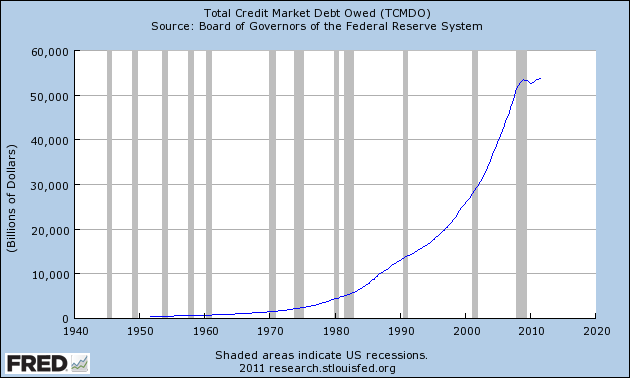
and then read Michael Synders blog at theeconomiccollapseblog.com
Something to mull over isn't it? Here in Australia we have the same attitude - stick your head in the ground and hope it will all go away.
Yet it isn't just an economic crash we are speaking of is it? How will people respond in the midst of being left destitute and perhaps so destitute they wonder how they will feed themselves and their family? Will they be like the children in Lord of the flies? The Bible warns us many will be lovers of themselves, void of any love for parents or others. That is what we are already seeing happen around us today in our culture.
In the midst of all this, truly only God's peace will suffice.
Gary
Tuesday, December 20, 2011
Culture and Christianity the debate continues
Just yesterday Tim Keller wrote that the "Cultural Transformationists" and the "Two Kingdoms" adherent were getting closer in fairly representing and debating the issues than ever before, a good thing for Reformed Evangelicals. He clarifies the issues and it can be read here. As Keller describes it, Transformationists "Though different in significant ways, they all believe Christians should be about redeeming and changing the culture along Christian lines." Two Kingdom adherents "the opposite---that neither the church nor individual Christians should be in the business of changing the world or society"
Michael Horton doesn't agree totally with Keller's description of the "Two Kingdom's" view so that also needs careful persual read it here.
A must read is the article in Themelios by Dan Strange which is very thought provoking about these issues. However it is a footnote in this article by Strange that I want reflect upon in terms of considering a person's assumptions in the arguments the Culture itself presents as cogent, reasonable and "convincing".
Consider Stranges footnote #72
Michael Horton doesn't agree totally with Keller's description of the "Two Kingdom's" view so that also needs careful persual read it here.
A must read is the article in Themelios by Dan Strange which is very thought provoking about these issues. However it is a footnote in this article by Strange that I want reflect upon in terms of considering a person's assumptions in the arguments the Culture itself presents as cogent, reasonable and "convincing".
Consider Stranges footnote #72
As Julian Rivers pointed out in 2004, ‘It may be that a culture deviates in some respect from the law of God to such an extent that some moral positions seem defensible to Scripture alone. We may rapidly be reaching that point in the Western world as regards sexual ethics’ (‘Public Reason’, Whitefield Briefing 9:1 [May 2004]: 4). One thinks here of a country like Switzerland currently discussing the decriminalization of consensual incest and the U.S. case of David Epstein, charged with having a three-year affair with his adult daughter. Epstein’s lawyer said to ABCNews, ‘Academically, we are obviously all morally opposed to incest and rightfully so. At the same time, there is an argument to be made in the Swiss case to let go what goes on privately in bedrooms. It’s OK for homosexuals to do whatever they want in their own home. . . . How is this so different? We have to figure out why some behavior is tolerated and some is not’(http://www.huffingtonpost.com/2010/12/15/david-epsteins-lawyer-we-_n_797138.html).
To which I hope that we’d point out the assumption behind the thinking that ‘what is carried out in private is of no concern to anybody else’ is “that what I do in private doesn’t affect anybody else”. But this ignores how such activities affect one’s character and relationships in the public sphere. One cannot divorce their worldview that allows and condones such behavior from how they relate the rest of the time in public.
Just something to ponder.
regards,
Gary
Tuesday, November 22, 2011
Why Twitter is an idol
Just recently I saw a great articles labeled iphone, ipad, idol - apart from being witty it was pretty much right on.
It got me thinking when on the evening news there was a piece about twitter. If you reflect upon it, twitter is all about me. People tweet their latest irrelevancy, what I am eating, what I am doing this instant, where I am going, who I am meeting, my observation of some item of culture or news or fad or point of view in less than 140 characters.
In that sense alone it is an idol because that idol is ME.
Now perhaps people are looking for intimacy, for connection on a relational level. But twitter doesn't promote it because it is a one sided conversation - it is "one hand clapping" because it doesn't allow for interaction, it doesn't allow for another person to respond. At least in a blog people can comment and you can enter into a dialogue with them.
However, there's another reason that Twitter is an idol and that is very intimately tied to the medium. It is because Twitter, being limited to 140 characters, and being used by so many people to post unconnected irrelevancies that it provides no context in which to understand the person making them. You would need a person to post minute by minute their life and You, yes You would have to read them just to get a bit of the context of their life and experiences so that you would get some meaningful context for what is being said.
In the end, who is going to read such a one sided monologue with a twit on the other end :)
Now of course you could say that you already know the person however much of the tweets people love to receive are of people that they actually don't know all that well.
So let me encourage you, sit down have a coffee and talk together. Ask them something about them, instead of focusing on hearing your own voice. You will gain so much more from being other person centred.
In Christ,
Gary
It got me thinking when on the evening news there was a piece about twitter. If you reflect upon it, twitter is all about me. People tweet their latest irrelevancy, what I am eating, what I am doing this instant, where I am going, who I am meeting, my observation of some item of culture or news or fad or point of view in less than 140 characters.
In that sense alone it is an idol because that idol is ME.
Now perhaps people are looking for intimacy, for connection on a relational level. But twitter doesn't promote it because it is a one sided conversation - it is "one hand clapping" because it doesn't allow for interaction, it doesn't allow for another person to respond. At least in a blog people can comment and you can enter into a dialogue with them.
However, there's another reason that Twitter is an idol and that is very intimately tied to the medium. It is because Twitter, being limited to 140 characters, and being used by so many people to post unconnected irrelevancies that it provides no context in which to understand the person making them. You would need a person to post minute by minute their life and You, yes You would have to read them just to get a bit of the context of their life and experiences so that you would get some meaningful context for what is being said.
In the end, who is going to read such a one sided monologue with a twit on the other end :)
Now of course you could say that you already know the person however much of the tweets people love to receive are of people that they actually don't know all that well.
So let me encourage you, sit down have a coffee and talk together. Ask them something about them, instead of focusing on hearing your own voice. You will gain so much more from being other person centred.
In Christ,
Gary
Wednesday, September 28, 2011
The quickening pace of the downhill slide of Wycliffe and SIL
I have already made brief comment on this blog about Christ's sonship in the context of Islam, but now Wycliffe and SIL reveals a foreign worldview at work than the Scriptures in their translation of those very Scriptures.
In my mind they have been captivated by the vain philosophies of this world.
Read World Magazines fair report and a highlighting of the issues involved.
In Christ alone,
Gary
In my mind they have been captivated by the vain philosophies of this world.
Read World Magazines fair report and a highlighting of the issues involved.
In Christ alone,
Gary
Subscribe to:
Posts (Atom)